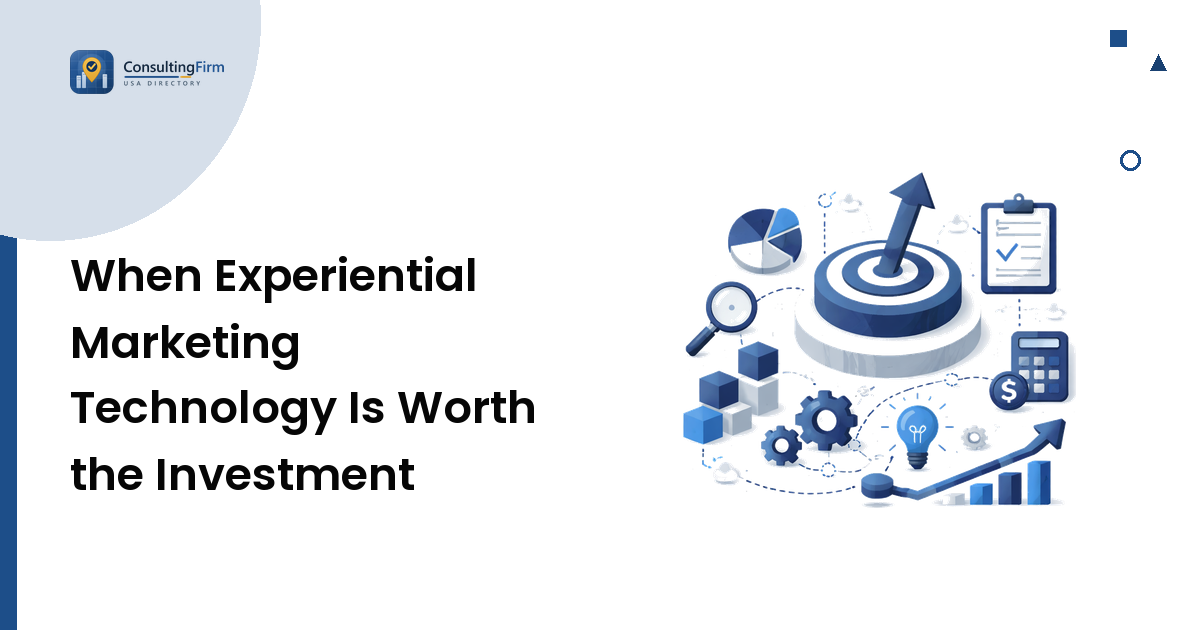
Experiential marketing technology — interactive screens, projection, AR activations, holographic displays — sells itself on a feeling. You see a crowd gathered around a floating product at a trade show and think "we should do that." That instinct is exactly the problem. The technology is designed to be impressive in the room, which tells you almost nothing about whether it will earn back what it costs your business. The decision deserves the same discipline you'd apply to any other capital or marketing spend.
The takeaway first: experiential tech is worth it only when a clear objective, a genuine fit, and a workable measurement plan all line up — and it's a waste the moment any one of them is missing. What follows is a framework you can run this week, before a vendor's demo does your thinking for you.
Step 1: Name the objective it's supposed to serve
Impressive is not an objective. Before anything else, write down the specific job you'd be hiring this technology to do. Most experiential tech serves one of these:
- Attention and footfall — stopping people in a crowded environment (a store window, a trade-show aisle, an event).
- Brand positioning — signaling "modern," "premium," or "innovative" before a word is read.
- Engagement and dwell — getting people to interact, stay longer, and remember you.
- Lead or data capture — converting that attention into a contact, a scan, or a sale.
Notice these are top-of-funnel and mid-funnel jobs. Experiential technology is generally strong at attention, positioning, and dwell, and weak at directly closing a considered sale on its own. If your actual problem is "we don't convert the leads we already have" or "our pricing is wrong," no display fixes that — and buying one is a distraction from the real work.
Step 2: Test the fit honestly
A technology can be excellent and still be wrong for you. Run your candidate against four fit tests, and be willing to fail it.
- Environment fit. Does your space suit it? Visual technologies that build an image from light — projection and holographic displays among them — need controlled, dimmer lighting and clear sightlines. Put one in a sun-flooded window and you've bought a faint blur. Match the tech to the room, or don't buy it.
- Message fit. Experiential tech shows one hero idea well and detail badly. If your message needs pricing, comparison, or fine print, this is the wrong primary medium.
- Audience fit. Does your customer actually pass through a physical space where the experience lands — a store, a booth, an event? A pure e-commerce business rarely gets its money's worth from a physical installation.
- Operational fit. Can you staff it, refresh the content, and support the follow-up? Novelty fades; an installation that never changes stops working, and attention with no next step leaks away.
If a candidate fails environment or audience fit, stop there. Those are structural, not fixable with a bigger budget.
Step 3: Cost the whole thing, not the hardware
First-time buyers anchor on the device price and get surprised by everything around it. Scope the total cost of ownership:
| Cost line | Why it's easy to miss |
|---|---|
| Hardware (buy or rent) | The only number vendors lead with |
| Content production | The effect only works with purpose-built creative; repurposed video rarely translates |
| Install, mounting, power | Placement, safety, and reliable power at the right spot |
| Staffing | Someone to run the demo and convert the moment |
| Refresh | New content on a schedule so novelty doesn't die |
For a first activation, renting almost always beats buying: it caps your downside, lets you test in your real environment, and defers the capital decision until you have evidence. Buy only after a pilot proves the numbers.
Step 4: Decide how you'll know it worked
Pick the metric before you spend, and match it to the objective from Step 1 — not to what's easiest to count.
- For attention: stopping rate and dwell time (sensor counts or simple observation).
- For engagement: interactions, scans, or time spent.
- For leads: contacts or scans tied specifically to the activation.
- For lift: compare footfall, sales, or recall during the activation against a matched period or a comparable location without it.
Crucially, judge experiential tech by the job it actually does. Holding it to a last-click sales number it was never meant to produce will make a working attention tool look like a failure — and letting it off the hook entirely lets a novelty coast on vibes. Set a realistic benchmark, then hold the spend to it.
The go / no-go summary
Green-light the investment when all of these are true:
- You've named a specific objective the tech is genuinely good at.
- It passes environment, message, audience, and operational fit.
- You've costed content, install, staffing, and refresh — not just hardware.
- You have a metric and a benchmark set in advance.
- You can pilot (rent) before you commit capital.
If you can't check every box, the honest move is to wait, rent a smaller test, or put the money into a higher-certainty channel. And if the analysis is genuinely close or high-stakes, this is a reasonable moment to bring in an outside marketing or strategy perspective — a second set of eyes often pays for itself by preventing a five-figure mistake.
FAQ
Isn't experiential marketing just for big brands with big budgets?
No. Smaller businesses can get strong returns from a modest, well-targeted activation — especially at events or in a storefront — precisely because the format cuts through. The discipline matters more than the budget: a small, measured pilot beats a large, unaccountable spend.
How do I avoid buying tech just because it looked cool in a demo?
Run the framework before the demo, not after. Write your objective, fit tests, and success metric down first, then judge any vendor's pitch against your own criteria. If the tech can't serve a job you'd already decided mattered, the impressive demo is a reason to be more cautious, not less.
Should I rent or buy experiential marketing technology?
For a first activation, rent. It caps your risk, lets you test in your actual environment and audience, and gives you real numbers before a capital decision. Buy only once a pilot has shown the activation earns its keep and you expect to reuse it.
What's the most common way this investment goes wrong?
Mismatched fit — usually environment or audience. A light-based display in a sunlit window, or a physical installation for a business whose customers never visit a physical space, fails no matter how good the hardware is. The second most common failure is no measurement plan, so no one can tell whether it worked.
How does a display drive actual revenue if it's top-of-funnel?
By being one connected step in a funnel, not the whole thing. It stops and engages people; a clear next step — staff, an offer, a scan, the real product beside it — turns that attention into a lead or sale. Without the next step, the attention is real but wasted.
The bottom line
Experiential marketing technology is neither a gimmick nor a guaranteed win — it's an investment that pays off under specific, checkable conditions. Name the objective, test the fit, cost the whole thing, and decide your metric before a vendor's demo decides for you. If a holographic display clears every bar in the framework, scope it with a specialist like Innaya and pilot it before you scale. If it doesn't clear the bar, the disciplined choice is to pass — and knowing the difference is exactly the kind of decision that separates spending from investing.