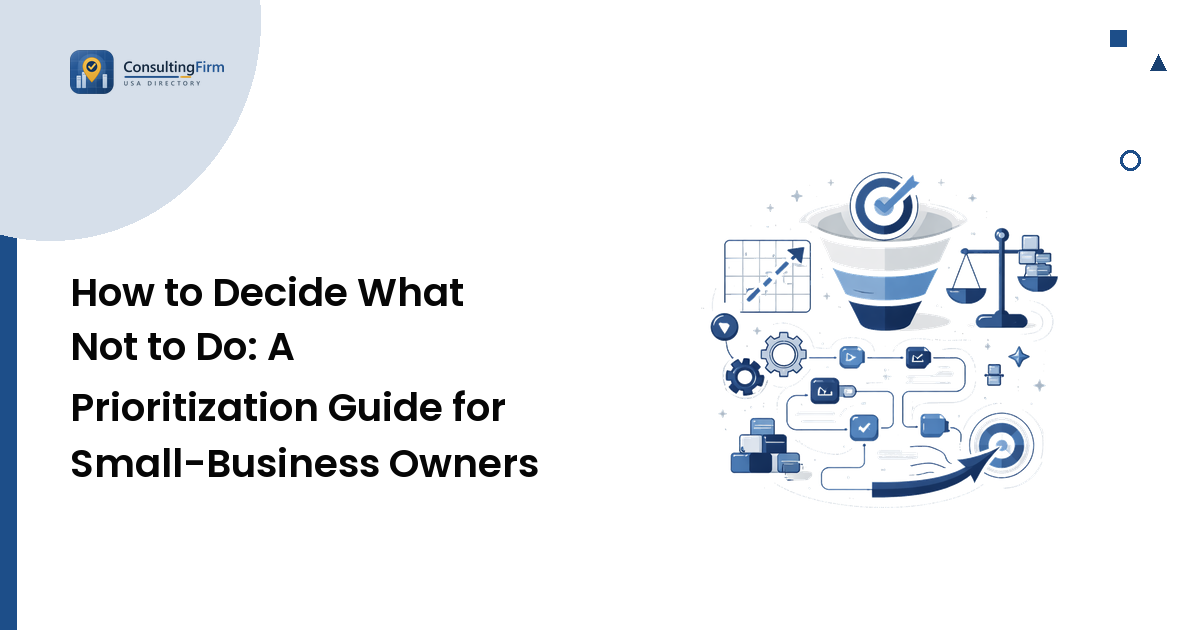
Most small-business owners are not short on things to do. They are short on things they have decided not to do. The plate keeps filling — a new channel to test, a customer request to accommodate, a tool to evaluate, a report someone wants — and each item looks reasonable on its own. The problem is never a single bad choice. It is the slow accumulation of decent-but-optional work that crowds out the two or three things that actually move the business.
The takeaway up front: prioritization is subtraction, not sorting. A to-do list ranked from top to bottom still assumes you will do all of it eventually. Real focus comes from deciding what falls off the list entirely — and being willing to say no, out loud, to work that is fine but not important. This guide walks through how to make those cuts on purpose instead of by exhaustion.
Busy is not the same as focused
The most dangerous state for an owner is productive-feeling busyness: long days, a full calendar, real work getting done — pointed at things that do not matter much. It feels like progress because effort and motion are easy to confuse with results. But a business is moved by a handful of decisions and activities, not by the total volume of tasks completed. Clear a hundred small items and you can still end the quarter exactly where you started.
The reason this trap is so common is that everything on the list is genuinely defensible. Almost nothing you do is useless. The question is never "is this worth doing?" — the answer is usually yes. The question is "is this worth doing instead of the most important thing I could do with that hour?" That comparison is what turns a pile of reasonable tasks into a real set of priorities. Strategy tells you where the business is trying to win; prioritization is how you protect the time to get there. If you have not written down where you compete and how you win, do that first — the business strategy guide covers it — because you cannot decide what not to do until you know what you are trying to do.
Score the work: impact against effort
You cannot prioritize a vague list. Start by making the work visible: write down everything currently on your plate — projects, recurring tasks, open requests, the things nagging at the back of your mind. Get it out of your head and onto one page. A list you can see is one you can cut; a list you carry around is one that carries you.
Then score each item on two axes, quickly and honestly:
- Impact: if this goes well, how much does it actually move the business — revenue, cost, risk, or the strategy you are trying to run? Be strict. "Nice to have" is low impact even when it is genuinely nice.
- Effort: how much of your time, attention, and money will it really take, including the follow-through most people forget to count?
That gives you four rough buckets, and each has a different verdict. High impact and low effort is where you start — do these now; they are the closest thing to free money you will find. High impact and high effort is the real work of the business — schedule it deliberately and protect the time, because this is the category that busyness quietly steals from. Low impact and low effort is the seductive middle — the quick wins that feel productive and add up to a day gone with nothing important moved; batch them, delegate them, or let them wait. Low impact and high effort is the trap — cut it, and be suspicious of anything that landed here because it is fun, familiar, or someone else's priority you absorbed without deciding to.
The discipline is in the fourth bucket. Most overloaded owners are not drowning in high-effort, high-impact work — they are drowning in low-impact work they never explicitly chose to stop. Naming those items and killing them is the whole game.
Protect two or three priorities, not ten
A common mistake is to finish the scoring exercise and declare eight "priorities." Ten priorities is zero priorities — the word means the first thing, and a business the size of yours can genuinely push on only two or three big things at once. Anything you elevate to a real priority should get protected time on the calendar and a claim on your attention when things get busy. If everything is protected, nothing is.
So force the ranking. Of everything in your high-impact buckets, which two or three matter most this quarter? Those are your priorities. Everything else — even the good stuff — is explicitly second-tier: it gets done in the gaps, gets delegated, or gets deferred to a later quarter without guilt. Writing "not now" next to a good idea is not giving up on it; it is refusing to let it dilute the things that come first. Revisit the list each quarter, because the right priorities change as the business does.
This is also where prioritization connects to how the work actually runs. A priority that lives only in your head competes badly against the daily flood of requests. Turn it into scheduled time, a named owner, and a clear outcome — the same discipline that makes any workflow reliable, covered in the operations guide — so the important work has a defended place to happen instead of hoping to survive the week.
Learn to say no without burning the bridge
Deciding what not to do is only half the job. The other half is declining the work when it comes from a customer, an employee, or a partner — and doing it in a way that protects the relationship. Owners avoid this because a blunt no feels costly, so they say a soft yes instead and quietly overload themselves. A vague yes you cannot deliver on damages trust far more than a clear, respectful no.
A good no does three things: it is prompt, it is honest about the reason, and it leaves the door open. "We are focused on X this quarter, so we cannot take this on now — let's revisit in the fall" tells the truth, respects the other person's time, and keeps the relationship intact. You do not owe a long justification, and over-explaining often reads as an opening to negotiate. Say what you are protecting and why, then hold it.
The same logic applies inward. When a team member brings a new idea that is genuinely good but off-priority, the answer is not "no, that's bad" — it is "yes, and it goes in the queue behind the two things we agreed matter most." That keeps people bringing ideas while keeping the focus intact.
Make the cut a habit, not a one-time purge
A single afternoon of ruthless prioritization feels great and lasts about two weeks, because the plate refills. The list grows back through the same slow accumulation that filled it the first time, one reasonable yes at a time. The fix is a standing rhythm: a quick weekly review to catch new work before it embeds, and a deeper quarterly reset to re-rank the big priorities as the business changes.
A useful rule for the weekly pass: nothing important gets added until something gets removed or finished. Your capacity is fixed, so treat it like a budget. When a new commitment comes in, ask what it displaces — and if the honest answer is one of your two or three priorities, the new thing is the one that waits. Prioritization stops being a painful annual cleanup and becomes a small, routine decision you make every week: not "what can I fit in?" but "what earns the space?"
Frequently asked questions
How do I prioritize when everything feels important?
Make the list visible, then score each item on impact and effort instead of arguing about it in your head. When you compare tasks head-to-head on how much they actually move the business against what they cost you, a real order appears — and the low-impact work you had been treating as urgent usually falls to the bottom, where it can be cut or deferred.
What is the difference between being busy and being focused?
Busy is high activity; focused is activity pointed at the few things that matter. A business is moved by a handful of decisions, not by the volume of tasks completed, so you can fill every day with reasonable work and still end the quarter having moved nothing important. Focus is what is left after you subtract the defensible-but-optional work.
How many priorities should a small business have at once?
Two or three big ones per quarter. "Priority" means the first thing, and a company with 5 to 250 employees can genuinely push hard on only a few things at a time. If you have eight priorities, you have none — force the ranking, protect calendar time for the top two or three, and let everything else be explicitly second-tier.
How do I say no to a customer or employee without damaging the relationship?
Be prompt, honest about the reason, and leave the door open. A clear "we're focused on X this quarter, so we can't take this on now — let's revisit later" protects the relationship far better than a vague yes you cannot deliver. You do not owe a long justification; state what you are protecting and hold it.
Next step
Focus is not a personality trait you either have or lack — it is a decision you make on purpose, over and over. The owners who seem calm and productive are not doing more; they have decided what not to do and defended that choice against a hundred reasonable requests. List everything on your plate this week, score each item on impact and effort, cut or defer the bottom half, and protect the two or three things that actually matter. If you want a second set of eyes on where your time is going and what to stop, talk to a consultant.